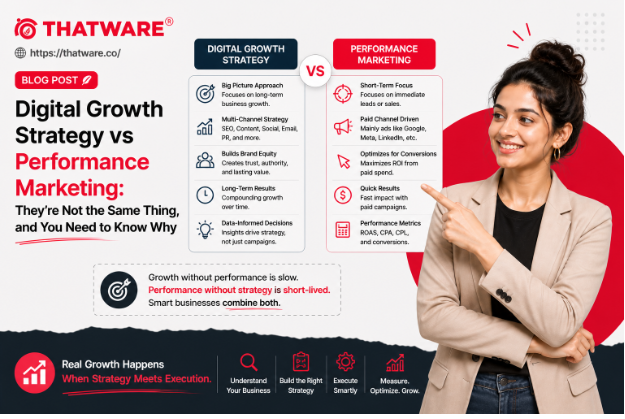
The conflation of “digital growth” and “performance marketing” in agency conversations has become a source of real confusion for brands trying to build coherent marketing strategies. The terms are often used interchangeably. They’re not synonymous, and treating them as such leads to underinvestment in the kinds of marketing that produce durable results.
Here’s a clear-eyed account of the difference and why it matters for how you allocate your marketing investment.
What Performance Marketing Actually Means
Performance marketing is marketing where you pay for measurable outcomes – clicks, leads, purchases – and the relationship between spend and output is direct and roughly linear. Google Search Ads, Meta ads, programmatic display, influencer posts with tracked links – these are performance marketing channels. You spend $10,000 and you expect a measurable volume of clicks, leads, or sales in return. Turn off the spend, and the output stops immediately.
This is genuinely useful. Performance marketing is highly controllable, highly measurable, and highly responsive. It’s also expensive at scale, doesn’t compound over time, and produces customer relationships that are transactional by nature.
What a Digital Growth Agency Does Differently
A digital growth agency operates from a different investment philosophy. Growth strategy investments – SEO, content marketing, brand building, community development, email list cultivation – are less immediately responsive and less cleanly measurable in the short term. They also compound in ways that performance marketing doesn’t.
Organic search traffic earned through six months of content investment continues to arrive after the investment period. Email subscribers acquired through content keep receiving communications that produce revenue over time. Brand reputation built through consistent quality content makes every subsequent marketing activity more efficient – because the audience you’re marketing to has a prior positive association with your brand.
The compounding dynamic is the core advantage of growth strategy over performance marketing. The investments accumulate value rather than simply producing and consuming it.
The Time Horizon Question
The choice between performance marketing and growth strategy is fundamentally a time horizon question. Performance marketing produces returns on the investment timeline. A full stack marketing agency working on growth strategy typically has a 12-24 month timeline before the compounding returns become clearly visible.
For businesses with short planning horizons – early-stage startups burning runway, businesses in seasonal categories that need to produce results in a specific window, businesses facing immediate competitive threats – performance marketing may be the more appropriate primary investment. For businesses with longer horizons – established brands building sustainable growth, subscription businesses optimizing lifetime value, businesses with significant total addressable markets – growth strategy typically produces better returns over the relevant period.
Why the Best Programs Use Both
The artificial tension between performance marketing and growth strategy misses the most important point: they work better together than either works alone. Performance marketing delivers immediate revenue while growth strategy builds the audience, authority, and organic demand that makes future marketing more efficient.
A SaaS company that has built genuine thought leadership through content and organic search will find that their paid search campaigns perform better – because when potential customers click a paid ad from a brand they recognize and trust, conversion rates are higher. An e-commerce brand with strong organic visibility sees lower CPAs in paid channels – because returning customers who initially discovered the brand through organic search have higher purchase intent when retargeted.
Framing the choice as performance versus growth obscures this synergy. The right frame is: what mix of immediate-return and compounding-return investment makes sense for our specific situation and timeline?
Evaluating Agencies on This Dimension
When evaluating agencies on their growth vs. performance orientation, look for teams that understand both well enough to be honest about trade-offs. An agency that sells only performance marketing without acknowledging the compounding value of growth investments is optimizing for its own measurability and accountability. An agency that sells only growth strategy without acknowledging the legitimate use cases for performance marketing is ignoring half the marketing toolkit.
The best partners help you navigate the allocation question honestly rather than steering you toward their preferred service line.